Nature-Based Solutions for Stormwater Management and Climate Adaption
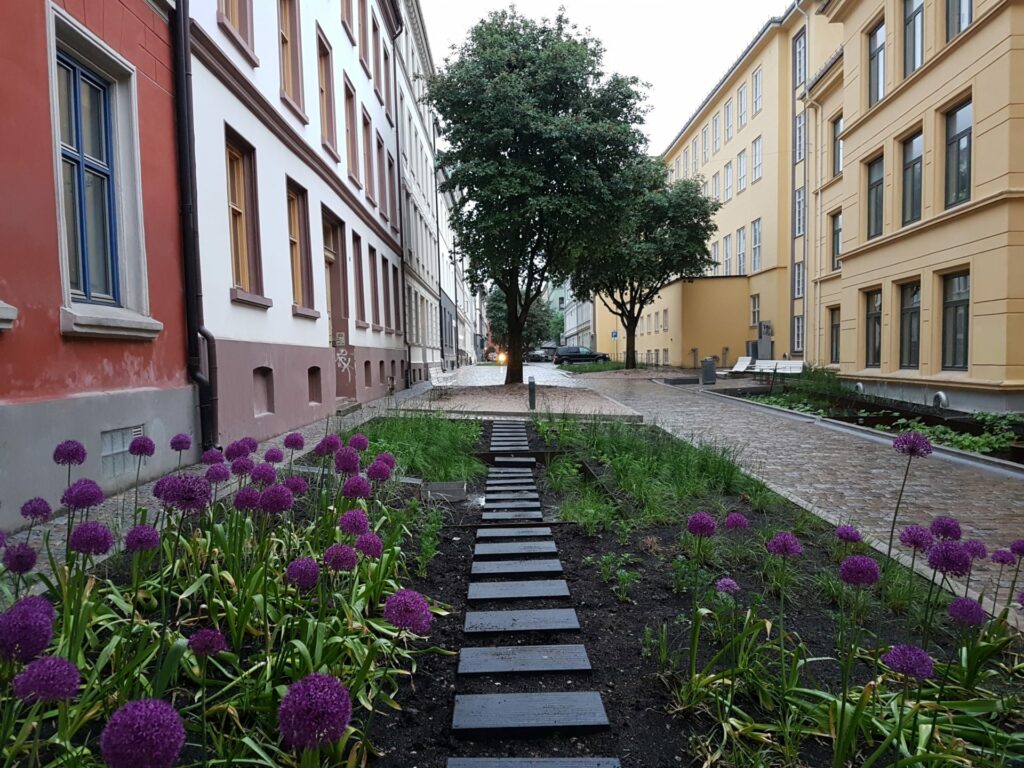
Photo: Rainbed in Deichmansgate Oslo illustrates naturebased and under ground solutions for heat and stormwater.
As Europe experiences more intense rainfall, flooding and urban heat, architects, municipalities and planning authorities face growing pressure to design resilient cities. At the same time, decision-makers need practical tools to evaluate climate adaptation strategies beyond traditional engineering solutions.
To address this need, SINTEF has developed VERBENA, a free online platform in Norwegian that brings together research-based tools for nature-based solutions (NbS), stormwater management and climate adaptation. SINTEF (formerly the Foundation for Industrial and Technical Research, Norway) is one of Europe’s largest independent research institutes.
The platform is freely available and designed for architects, landscape architects, urban planners, municipalities, consultants and developers seeking evidence-based approaches to resilient urban development.
Nature-Based Solutions Deliver More Than Stormwater Management
Across Europe, climate change is increasing the frequency of extreme rainfall while prolonged heatwaves are becoming more common. These challenges require cities to rethink how buildings, streets and public spaces are planned.
Nature-based solutions—including rain gardens, green roofs, permeable pavements and urban vegetation—are increasingly recognised as effective tools for managing stormwater close to where rainfall occurs.
Beyond flood mitigation, these solutions can provide multiple co-benefits, including:
- reducing urban heat
- improving air quality
- supporting biodiversity
- storing carbon
- creating healthier public spaces
- strengthening urban climate resilience
The Norwegian Government’s White Paper Climate in Change – Together for a Climate-Resilient Society (Meld. St. 26, 2022–2023) highlights the need for practical tools that support the implementation of nature-based solutions and help quantify their wider environmental and socio-economic benefits.
Supporting Healthier and More Resilient Cities
Urban vegetation also plays an important role in protecting public health during increasingly frequent heatwaves.
According to the World Health Organization (WHO), trees and green infrastructure reduce exposure to extreme heat through shading and evapotranspiration, helping lower heat stress and reducing heat-related health risks in cities.
Well-designed green infrastructure therefore contributes simultaneously to stormwater management, urban cooling, biodiversity, improved public health and climate resilience.
Trees and greenery can cool cities by as much as 18°C – but only if they’re the right type
Nature-based solutions are increasingly recognised as an important strategy for adapting cities to rising temperatures.
Recent international research comparing field measurements from Melbourne, Munich and Hong Kong found that how vegetation is designed may be as important as how much is planted.
The researchers observed that layered vegetation—combining trees, shrubs and ground cover—often reduced radiant heat more effectively than trees alone.
In Melbourne, street trees reduced pedestrian radiant heat exposure by more than 18°C compared with open streets. In Munich, layered planting reduced afternoon heat stress by almost 8°C.
The study also demonstrated that local climate conditions matter. In humid environments such as Hong Kong, dense vegetation may increase humidity or reduce airflow if not carefully designed.
The findings suggest that successful urban greening depends on vegetation structure, species selection and local climatic conditions rather than simply increasing tree numbers.
Bringing Research Together in One Platform
VERBENA builds on findings from several Norwegian research projects, including Sustainability Assessment of Climate Adaptation Measures in Rogaland and Indicators for Climate Adaptation of Buildings and Infrastructure in Municipalities.
While these projects produced valuable analytical methods, feedback from municipalities and practitioners showed that existing tools were often too complex for everyday planning.
VERBENA was developed to make this knowledge easier to access through a single, user-friendly digital platform.
Four Research-Based Decision Support Tools
MEASURE
An indicator-based assessment tool that enables municipalities to monitor and evaluate their climate adaptation work over time. It helps identify strengths, priorities and opportunities for continuous improvement.
GUIDE
Three practical checklists supporting climate adaptation in:
- municipal planning
- planning and construction projects
- stormwater management
The tool is intended for municipalities, planning authorities, public agencies and private developers.
ANALYSE
A decision-support tool that compares conventional stormwater infrastructure with nature-based solutions.
Rather than focusing solely on construction costs, the tool evaluates a broader range of technical performance, ecosystem services and societal benefits, supporting more informed planning decisions.
LEARN
A digital knowledge base covering 17 of the most common nature-based solutions for urban stormwater management.
Each fact sheet explains:
- how the solution works
- which climate challenges it addresses
- the ecological processes involved
- design and maintenance requirements
- examples from Norwegian projects where available
Better Decision-Making for Future Projects
For architects, landscape architects, municipalities, planning authorities and developers, nature-based solutions are becoming an essential part of climate-resilient urban design.
VERBENA translates research into practical planning tools that support better decision-making throughout the design process.
By making the multiple benefits of nature-based solutions easier to evaluate and document, the platform helps professionals move beyond conventional drainage strategies towards more sustainable, resilient and liveable cities.
References
- Norwegian Ministry of Climate and Environment. (2023). Climate in Change – Together for a Climate-Resilient Society (White Paper No. 26, 2022–2023).
- Rahman, M.A. et al. (2025). Trees and greenery can cool cities by as much as 18°C – but only if they’re the right type. The Conversation. https://theconversation.com/trees-and-greenery-can-cool-cities-by-as-much-as-18-c-but-only-if-theyre-the-right-type-283071
- Sivertsen, E. et al. (2025). VERBENA – Free Tools for Nature-Based Stormwater Solutions. SINTEF. https://www.sintef.no/siste-nytt/2025/her-far-kommunene-gratis-hjelp-med-naturbaserte-losninger-for-overvann/
- World Health Organization (WHO). (2016). Urban Green Spaces and Health.