The Value Map: Holistic Tool for Sustainable Development
Introduction: Why the Industry Needs Better Sustainability Tools
If we are to develop buildings, cities, and other environments that fulfil the purpose of sustainable development, we need tools to set objectives, plan, and evaluate. Such tools are necessary to create a solid foundation for planning, comparing alternatives, and improving proposals.
The Value Map method was primarily developed for buildings and urban development but is also applied to other products and development processes. It is not an abstract explanation, but a practical tool that can be used for programming and design as well as – importantly – for later post-evaluation.

What Is the Value Map? A Practical Sustainability Tool
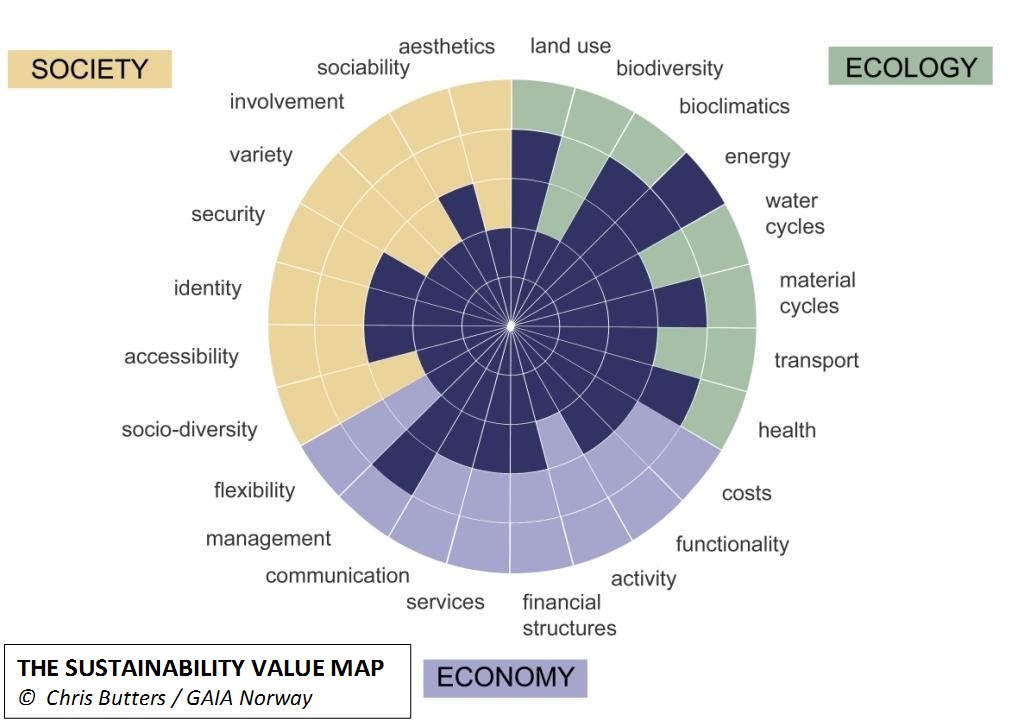
The Value Map is a structured benchmarking method built around three equally weighted pillars:
- Ecology
- Economy
- Society
Each pillar is assessed through eight parameters (24 in total), though simplified versions are possible. For each parameter, performance is scored from 0 to 4:
- 0 – Below current standard
- 1 – Conventional minimum practice
- 2 – Significantly better than current practice
- 3 – Very good / excellent
- 4 – Sustainable – as good as achievable today
The result is presented graphically in a circular format that immediately reveals strengths, weaknesses and imbalances.
The tool is intuitive. It is designed to support interdisciplinary dialogue, not replace it.
A Broader Understanding of Sustainability
Sustainability cannot be reduced to energy intensity.
A working definition:
Sustainability means long-term, socially and economically positive development within the carrying capacity of ecosystems.
This implies movement — a dynamic process. Ambition levels must evolve as standards improve.
The Value Map emphasises balance. A zero-energy building that is unaffordable, socially alienating or aesthetically poor cannot be considered sustainable in any meaningful sense.
Why Weighting Is Misleading
Many systems struggle with weighting different criteria. The Value Map deliberately avoids this.
Weighting is context-dependent. Water scarcity matters more in arid climates than in Norway. Therefore, all parameters are given equal weight structurally, while project teams may prioritise specific issues strategically.
The objective is not optimisation of one parameter, but equilibrium across all three domains.
Quantities and Qualities Must Be Evaluated Together
One of the most important contributions of the Value Map is its integration of quantitative and qualitative factors.
Quantitative (measurable)
- Energy use (kWh/m²·year)
- Emissions
- Material flows
- Cost metrics
Qualitative (experiential and social)
- Safety (perceived and actual)
- User participation
- Accessibility
- Adaptability
- Cultural and aesthetic value
Energy performance can be measured precisely. But safety, participation and management quality require sociological methods and user evaluation.
How the message is communicated is crucial. The presentation of the Value Map is intuitive and easy to grasp.
While most people use the familiar triad ecology – economy – society, some adopt four main areas. For example, Spangenberg, writing for the UN, adds a fourth dimension – “the institutional”. This is unnecessary, as institutional processes are fully covered by the concept of economy.
Economy must be understood in its original, much broader sense than GDP or income alone. The Greek oikonomia means “household” – that is, the organisation of society. Economic sustainability refers to a system and institutions that are robust, diverse, flexible, and well-organised enough to function over the long term and ensure welfare for the majority.
The goal is that all architecture and place-making should fulfil the three main aims of sustainability – with a good balance among them. In the Value Map, each of the three areas is assessed according to eight parameters. For each parameter, goals and benchmarks must be established, either in detailed or simplified form. Together, in the Value Map circle, this provides a holistic overview of a project’s sustainability profile.
The key insight:
Quantitative factors ultimately express qualities — and qualitative factors must also be assessed systematically.
Application Across Scales
The Value Map can be applied to:
- Building components (e.g. material choices)
- Single buildings
- Neighbourhoods
- Cities
- Regions
It supports life-cycle thinking and post-occupancy evaluation.
Example: Window Replacement vs. Refurbishment
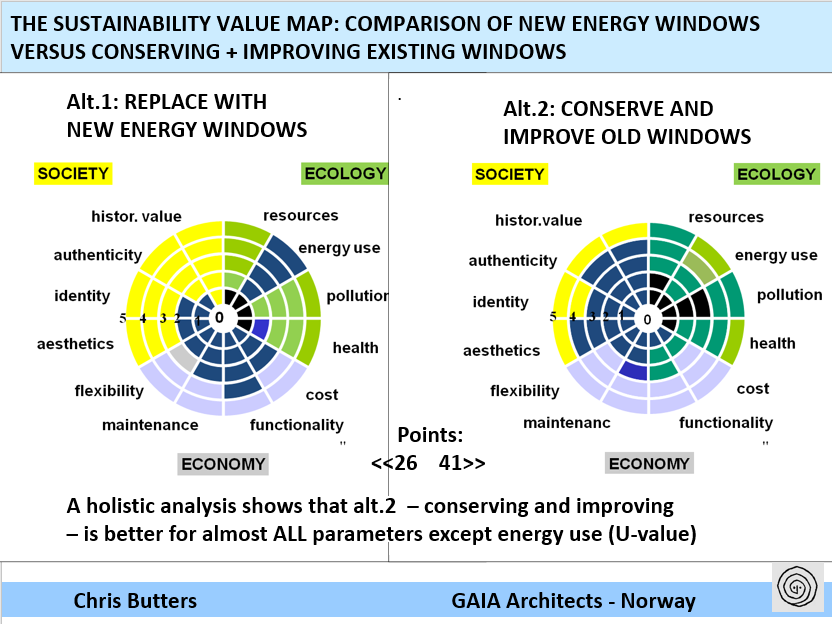
In an assessment developed for Riksantikvaren, the tool compared replacing old windows with energy-efficient new units versus preserving and upgrading original windows.
The energy gain was clear in the replacement option. However, when ecological, economic and social parameters were assessed holistically, refurbishment proved competitive or superior overall.
The Value Map does not dictate answers. It structures better questions.
Management and User Behaviour: The Missing Link
Technical specialists often focus on environmental technologies because they are measurable. However, sustainability outcomes depend heavily on users.
Energy reduction may result partly from improved systems — but also from clearer billing, feedback and behavioural change.
Sustainability cannot be delivered. It can only be enabled through intelligent, user-oriented design.
For building owners, this has direct financial implications:
- Reduced operational risk
- Higher tenant satisfaction
- Longer asset life
- Stronger ESG positioning
From Fragmentation to Wholeness
Historically, holistic models predate modern sustainability discourse. Thinkers such as:
- Patrick Geddes
- Frédéric Le Play
worked with triadic structures linking people, function and environment.
The Value Map continues this tradition. It also resonates with systems theory, circular economy thinking, and eco-philosophical perspectives such as:
- Arne Næss and Deep Ecology
The core message for professionals today is practical:
Sustainability requires interdisciplinary competence and ethical awareness — not just advanced modelling tools.
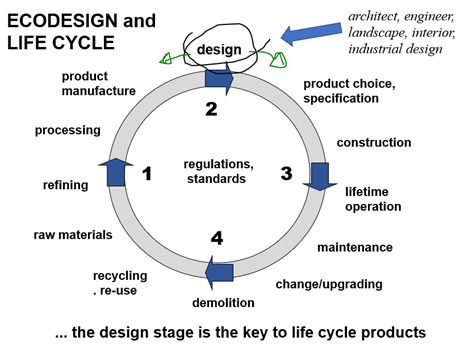

Photo: Chris Butters. A round building in China.
Implications for Building Owners, Architects and Engineers
For Building Owners
- Supports long-term value creation
- Clarifies investment trade-offs
- Reduces reputational and regulatory risk
- Aligns sustainability with asset management
For Architects
- Integrates ecological, economic and social design intentions
- Encourages balanced form-making and place-making
- Supports stakeholder dialogue
For Engineers
- Connects technical optimisation with societal outcomes
- Prevents over-specialisation
- Enhances collaboration across disciplines
The Strategic Advantage of the Value Map
Many sustainability systems are overly complex or environmentally narrow. The Value Map stands out because it:
- Is visually intuitive
- Is adaptable to context
- Encourages strict but balanced assessment
- Bridges quantitative and qualitative domains
- Works across scales and life-cycle phases
It is not a theoretical model. It is a decision-support tool.
Conclusion
Sustainable development cannot be evaluated through mechanistic tools alone. Digital modelling, life-cycle assessment and detailed calculations are indispensable — but insufficient in isolation.
The Value Map compels a holistic perspective. It reveals imbalances, stimulates interdisciplinary dialogue and strengthens decision-making.
For building owners, architects and engineers seeking long-term resilience and meaningful sustainability outcomes, the Value Map provides a structured, operational and future-oriented framework.
Key Takeaways
- Sustainability requires balance between ecology, economy and society
- The Value Map uses 24 parameters across three pillars
- Scoring is strict and benchmark-based (0–4 scale)
- Quantitative and qualitative criteria must be assessed together
- Weighting is context-dependent and structurally unnecessary
- The tool supports life-cycle and post-occupancy evaluation
- It enables better interdisciplinary decisions
- Sustainability cannot be delivered — only enabled
Library and further reading
Arne Naess and the Deep Ecology Movement | Springer Nature Link
Case: Vertikal Nydalen Oslo Radical environmental technology at Vertikal Nydalen Oslo