
LCA & EPD Guide for Building Owners, Architects & Engineers
LCA (Life Cycle Assessment) is a methodology used to quantify the environmental impact of a product throughout its life cycle — from raw material extraction to end-of-life disposal. LCA can include sensitive business information such as chemical use or innovations from manufacturers.
EPD (Environmental Product Declaration) is a public, standardized report of a product’s environmental impact based on LCA data verified by an independent third party.
The purpose of EPD is to provide decision-makers — including building owners, architects, and engineers — with comparable and transparent environmental information, enabling informed decisions early in a project. Contractors ensure that documentation requirements are met on behalf of the building owner.
EPDs are most commonly used for carbon footprint calculations to assess potential greenhouse gas reductions, often driven by owner requirements, and are increasingly expanded with metrics such as LULUC for forest conservation. However, manufacturers may sometimes omit newer or updated data.
Reference Buildings and Certifications
Reference projects with BREEAM level Excellent or Outstanding certification require carbon footprint calculations of construction materials.
Example: Spor-X in Drammen achieved BREEAM Outstanding certification.

Generic Data vs. Product-Specific EPD
Generic Data
- Based on average values from databases, often compiled by industry associations for concrete, timber, or steel.
- Typically used in early project phases before specific products are chosen.
- Useful for preliminary estimates and system selection.
Drawbacks:
- May not reflect the actual product chosen, which could have a significantly lower Global Warming Potential (GWP) due to innovation.
- Using generic data in place of product-specific EPDs in detailed phases can provide misleading environmental performance results.
Product-Specific EPD
- Based on actual LCA data from the manufacturer and specific production line.
- Must comply with international standards (e.g., ISO 14025, EN 15804) and be verified by an independent third party.
Advantages:
- More accurate and relevant for detailed design and procurement phases.
- Reduces the risk of incorrect conclusions in environmental assessments.
Challenges:
- Not all manufacturers provide EPDs.
- Verification quality varies, and some EPDs may be based on incorrect assumptions if the verifier lacks expertise.
- Most EPDs focus on Phase A (cradle-to-gate carbon emissions) and sometimes Phase B (transport to construction site).
Common Errors with EPD Data
Verified producers have documented issues such as:
- Generic or average data being used as “product-specific” without reflecting actual production.
- Incorrect reporting of recycled material content.
- Verification that does not ensure technical competence, leading to published errors.
Such errors can result in poor project decisions and greenwashing, where products appear more environmentally friendly than they truly are.
How to Use EPD Data Correctly in Building LCA
Recommended Data Hierarchy
- Product-specific EPD from manufacturer (EN 15804 / ISO 14025).
- Product-specific EPD from a technically similar product if unavailable.
- Industry-average or self-declared EPD within the same product category.
- Generic LCA values as a last resort.
Iterative Approach
- Use generic data in conceptual phases for high-level decisions.
- Switch to product-specific EPDs during detailed design and procurement for accurate, comparable results.
Avoiding Major Errors
Require Standards and Third-Party Verification
- All EPDs should follow:
- EN 15804 for construction products
- ISO 14025 for Type III environmental declarations
- Verified by an accredited third-party verifier according to ISO 17065 (certifies certification bodies)
Ensure Transparent Documentation
- Clear PCR (Product Category Rules) reference
- Open LCA data and module assumptions for verification
Cross-Check with Independent Databases
- Compare with ecoinvent, EPiC, or national LCA databases
- Conduct sensitivity analyses to understand data impact on results
Include Contractual Requirements
- Specify validated product-specific EPDs in contracts
- Define consequences for documentation errors, such as technical penalties or remedial measures
Tip: Consult experienced professionals involved in reference buildings to ensure reliable results.
ASKO Oslofjord logisticfacility: Highest level environmental certification
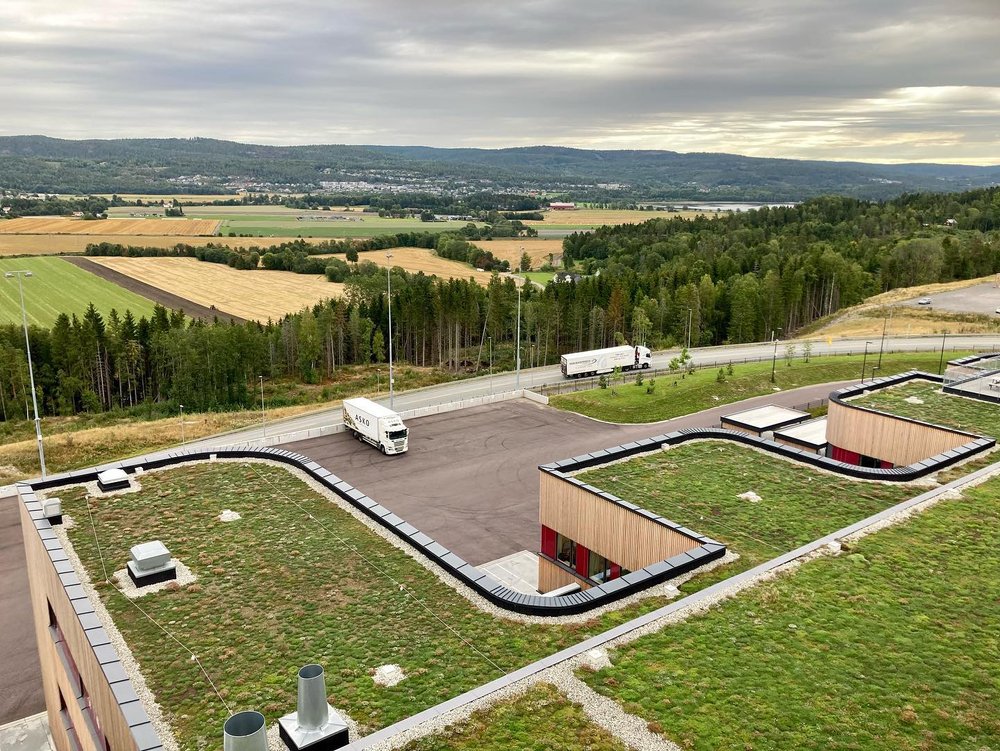
Textdescription and photos from Arkitektgruppen Drammen.
Comparing Key Metrics in EPD
EPDs should be compared for similar functions such as walls, roofs, foundations, windows, and evaluated holistically for maximizing reduction of environmental impacts.
Key indicators include:
GWP – Global Warming Potential
- Measures the accumulated warming effect of greenhouse gases relative to CO₂ over a chosen timeframe (usually 100 years).
- Expressed in CO₂-equivalents (CO₂e)
- Subdivided into:
- GWP Total = Fossil + Biogenic + LULUC
- GWP Fossil = Emissions from fossil fuel oxidation and carbonate processes
- GWP Biogenic = Biogenic CO₂ stored in or emitted from the product
- GWP LULUC = Land use and land-use change emissions and sequestration
Other Environmental Indicators
- ODP – Ozone depletion potential
- AP – Acidification potential
- EP – Eutrophication potential
- POCP – Photochemical ozone creation potential
- ADP (fossil, minerals & metals) – Abiotic depletion potential
- WDP – Water scarcity potential
- PM – Particulate matter
- IRP – Ionizing radiation
- ETP-f – Freshwater ecotoxicity
- HTPc – Human toxicity (carcinogenic)
- SQP – Soil quality
- PERE/RPEE / REPM/RPEM / PERT/TPE – Energy use
- Waste flows (A + D) – Outgoing useful flows from product system
Sources:
- LCA.no – Environmental impacts EN 15804 +A2
- Stockholm Resilience Centre –Planetary boundaries – Stockholm Resilience Centre
- World Greenbuilding INDICATE – World Green Building Council
Also read: FAQ: LCC in Buildings: How to boost Value from Design Phase
Publish sustainable solutions for architecture
post@greenbuilt.no